Uniting
Heaven and Earth
Uniting
Heaven and Earth
Think of the hardest job you’ve ever done. What made it hard? Was it the expectations or the time allotted for the work or both? Was it your attitude toward the task? Or perhaps it was the people you worked with? Or maybe it just seemed like an impossibility to ever succeed?
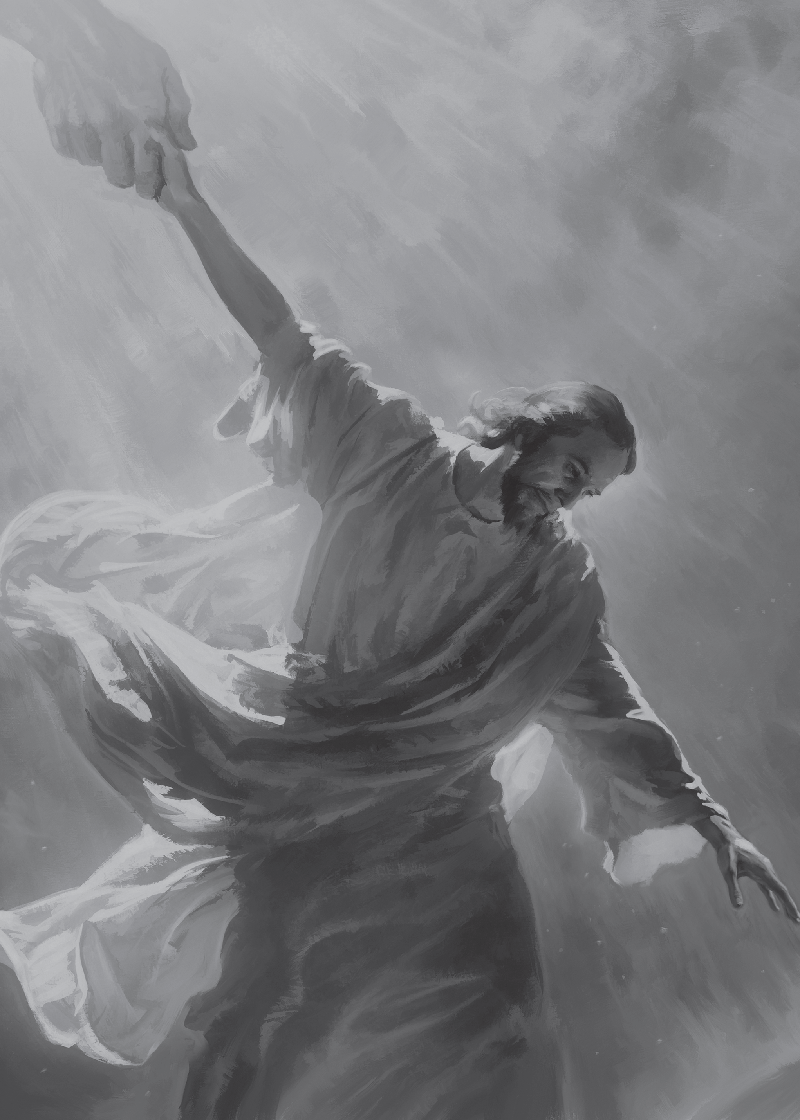
Consider the purpose of the plan of salvation: uniting heaven and earth. Sound impossible? Humanly speaking, it certainly is. Nevertheless, just before ascending to heaven, Jesus gave the apostles a seemingly impossible assignment: “Go therefore and make disciples of all the nations, baptizing them in the name of the Father and of the Son and of the Holy Spirit, teaching them to observe all things that I have commanded you” (Matt. 28:19, 20, NKJV).
Jesus sent Paul to the Gentiles to accomplish this seemingly impossible task: “ ‘To open their eyes, in order to turn them from darkness to light, and from the power of Satan to God, that they may receive forgiveness of sins and an inheritance among those who are sanctified by faith in Me’ ” (Acts 26:18, NKJV).
Some might throw up their hands when given jobs like that. However, we should not overlook the promises Jesus gave on both these occasions. To the apostles, He added, “And, lo, I am with you always, even unto the end of the world” (Matt. 28:20). And to Paul, Jesus said, “I have appeared to you for this purpose, to make you a minister and a witness both of the things which you have seen and of the things which I will yet reveal to you” (Acts 26:16, NKJV).
In short, Jesus gives humanly impossible tasks so we will rely on Him, rather than on ourselves, to accomplish them. He never gives us a job without supplying the power to do it. “As the will of man co-operates with the will of God, it becomes omnipotent. Whatever is to be done at His command may be accomplished in His strength. All His biddings are enablings.”—Ellen G. White, Christ’s Object Lessons, p. 333.
Amazingly, by the time Paul wrote to the Colossians, the gospel had been “preached to every creature under heaven” (Col. 1:23, NKJV). Of course, not all accepted it. But if we look carefully at the commissions He gave to the apostles (Matt. 28:18–20) and to the apostle Paul, Jesus never promised all would become disciples or all would be converted. The gospel is to be “preached in all the world as a witness to all the nations, and then the end will come” (Matt. 24:14, NKJV, emphasis supplied). What does that witness look like? How exactly is it to be accomplished?
This quarter we’ll study Paul’s epistles to the Philippians and to the Colossians. They have important similarities. Above all, they reveal Christ, the only One able to unite heaven and earth. He is the ladder Jacob saw stretching from earth to heaven (Gen. 28:12; compare John 1:51). As the Son of man and the Son of God, He redeems us from sin, and He intercedes for us.
In studying these letters, we will see both these aspects of Jesus. We’ll consider some of the most sublime statements found anywhere about Christ’s divinity and how He gave it all up to save us. We’ll see Paul wrestling from prison with problems in one church he raised up (Philippi) and in one that he himself never even visited (Colossae). The connections Paul established throughout the “world church” of that time enabled him, even from a Roman prison, to respond to challenges. He knew his time was short, and he did all he could to draw the church closer to heaven and to each other. In so doing, he shows us how God’s church today can unite with heaven to fulfill the last-day commission of Revelation 14, which we know as “the three angels’ messages.”
Clinton Wahlen, PhD, is an associate director of the Biblical Research Institute at the General Conference. His expertise is in the New Testament, hermeneutics, and Adventist history. He has lived and worked in Germany, New Zealand, Russia, the United Kingdom, and the Philippines. He and his wife, Gina, have two grown children, a daughterin- law, and two grandchildren.
Editorial Office 12501 Old Columbia Pike, Silver Spring, MD 20904 Come visit us at our website at https://www.adultbiblestudyguide.org
Principal Contributor Clinton Wahlen
Editor Clifford R. Goldstein
Associate Editor Soraya Scheidweiler
Publication Manager Lea Alexander Greve
Editorial Assistant Sharon Thomas-Crews
Pacific Press® Coordinator Miguel Valdivia
Art Director and Illustrator Lars Justinen
Design Justinen Creative Group
The teachers edition components were written by the following:
The Overview, Commentary, and Life Application, Lessons 1—13:
Adenilton Tavares de Aguiar, PhD; Theological Seminary, Adventist University Center of São Paulo, Brazil.
© 2026 General Conference of Seventh-day Adventists®. All rights reserved. No part of the Adult Sabbath School Bible Study Guide (Teachers Edition) may be edited, altered, modified, adapted, translated, reproduced, or published by any person or entity without prior written authorization from the General Conference of Seventh-day Adventists®. The division offices of the General Conference of Seventh-day Adventists® are authorized to arrange for translation of the Adult Sabbath School Bible Study Guide (Teachers Edition), under specific guidelines. Copyright of such translations and their publication shall remain with the General Conference. “Seventh-day Adventist,” “Adventist,” and the flame logo are registered trademarks of the General Conference of Seventh-day Adventists® and may not be used without prior authorization from the General Conference.
“The true teacher is not content with dull thoughts, an indolent mind, or a loose memory. He constantly seeks higher attainments and better methods. His life is one of continual growth. In the work of such a teacher there is a freshness, a quickening power, that awakens and inspires his [class].” —Ellen G. White, Counsels on Sabbath School Work, p. 103.
To be a Sabbath School teacher is both a privilege and a responsibility. A privilege because it offers the teacher the unique opportunity to lead and guide in the study and discussion of the week’s lesson so as to enable the class to have both a personal appreciation for God’s Word and a collective experience of spiritual fellowship with class members. When the class concludes, members should leave with a sense of having tasted the goodness of God’s Word and having been strengthened by its enduring power. The responsibility of teaching demands that the teacher is fully aware of the Scripture to be studied, the flow of the lesson through the week, the interlinking of the lessons to the theme of the quarter, and the lesson’s application to life and witness.
This guide is to help teachers to fulfill their responsibility adequately. It has three segments:
1. Overview introduces the lesson topic, key texts, links with the previous lesson, and the lesson’s theme. This segment deals with such questions as Why is this lesson important? What does the Bible say about this subject? What are some major themes covered in the lesson? How does this subject affect my personal life?
2. Commentary is the chief segment in the Teachers Edition. It may have two or more sections, each one dealing with the theme introduced in the Overview segment. The Commentary may include several in-depth discussions that enlarge the themes outlined in the Overview. The Commentary provides an in-depth study of the themes and offers scriptural, exegetic, illustrative discussion material that leads to a better understanding of the themes. The Commentary also may have scriptural word study or exegesis appropriate to the lesson. On a participatory mode, the Commentary segment may have discussion leads, illustrations appropriate to the study, and thought questions.
3. Life Application is the final segment of the Teachers Edition for each lesson. This section leads the class to discuss what was presented in the Commentary segment as it impacts Christian life. The application may involve discussion, further probing of what the lesson under study is all about, or perhaps personal testimony on how one may feel the impact of the lesson on one’s life.
Final thought: What is mentioned above is only suggestive of the many possibilities available for presenting the lesson and is not intended to be exhaustive or prescriptive in its scope. Teaching should not become monotonous, repetitious, or speculative. Good Sabbath School teaching should be Bible-based, Christ-centered, faith-strengthening, and fellowship-building.