LESSON 5 *July 26–August 1
Sabbath Afternoon
Read for This Week’s Study: Exod. 11:1–10, Mic. 6:8, Exod.12:1–30, 1 Cor. 5:7, Exod. 13:14–16, Heb. 11:28.
Memory Text: “ ‘And it shall be, when your children say to you, “What do you mean by this service?” that you shall say, “It is the Passover sacrifice of the Lord, who passed over the houses of the children of Israel in Egypt when He struck the Egyptians and delivered our households” ’ ” (Exodus 12:26, 27, NKJV).
The tenth and last plague is about to fall. The last warning is given; the final decision must be made. It’s truly a matter of life or death. Not only the life of an individual but the prosperity of families and the entire nation is at stake. Pharaoh and his officials will be responsible for the fate of many people, either for life or for death. Pharaoh’s attitude toward the living God of Israel will determine not just his future but that of his nation.
How do we feel, and what do we do, when the gravity of circumstances lies heavy upon us and we have to choose the next step and direction, a choice that can greatly impact the lives of many others besides ourselves?
God is more than willing to grant us wisdom, understanding, and power to do what is right (1 Cor. 1:30, Phil. 2:13).
The problem, however, is that, in our own stubborn hearts, we don’t always want to do what is right. We know what it is, but we refuse to do it. In the account of the Exodus, one man’s refusal to submit to God, even in face of overwhelming evidence, brought tragedy upon many others besides himself, which is often how it works, anyway.
* Study this week’s lesson to prepare for Sabbath, August 2.
EGW Notes — SATURDAY ↓
Sabbath Afternoon, July 26
Lesson 5 - Passover
The observance of the Passover began with the birth of the Hebrew nation. On the last night of their bondage in Egypt, when there appeared no token of deliverance, God commanded them to prepare for an immediate release. He had warned Pharaoh of the final judgment on the Egyptians, and He directed the Hebrews to gather their families within their own dwellings. Having sprinkled the doorposts with the blood of the slain lamb, they were to eat the lamb, roasted, with unleavened bread and bitter herbs. “And thus shall ye eat it,” He said, “with your loins girded, your shoes on your feet, and your staff in your hand; and ye shall eat it in haste: it is the Lord’s passover.” Exodus 12:11. At midnight all the first-born of the Egyptians were slain. Then the king sent to Israel the message, “Rise up, and get you forth from among my people; . . . and go, serve the Lord, as ye have said.” Exodus 12:31. The Hebrews went out from Egypt an independent nation. The Lord had commanded that the Passover should be yearly kept. “It shall come to pass,” He said, “when your children shall say unto you, What mean ye by this service? that ye shall say, It is the sacrifice of the Lord’s passover, who passed over the houses of the children of Israel in Egypt, when He smote the Egyptians.” Thus from generation to generation the story of this wonderful deliverance was to be
repeated.—The Desire of Ages, p. 76.
The Lord then gave Moses special directions, to give to the children of Israel, in regard to what they must do to preserve themselves and their families from the fearful plague that he was about to send upon Egypt. Moses was also to give them instructions in regard to their leaving Egypt. He related to them the command of God to slay a lamb without blemish, and take the blood of the lamb and strike it upon the door-posts, and also upon the upper door-posts of their houses. And while this token should be without for a sign, and they should be eating the lamb, roasted whole, with bitter herbs, within, the angel of God would be passing through the land of Egypt doing his dreadful work, slaying the first-born of man and the first-born of beast. “And thus shall ye eat it, with your loins girded, your shoes on your feet, and your staff in your hand; and ye shall eat it in haste. It is the Lord’s passover. For I will pass through the land of Egypt this night, and will smite all the first-born in the land of Egypt, both man and beast; and against all the gods of Egypt I will execute judgment. I am the Lord. And the blood shall be to you for a token upon the houses where ye are. And when I see the blood, I will pass over you, and the plague shall not be upon you to destroy you, when I smite the land of Egypt. And this day shall be unto you for a memorial; and ye shall keep it a feast to the Lord throughout your generations. Ye shall keep it a feast by an ordinance
forever.”—Spiritual Gifts, vol. 3, p. 222.
SUNDAY July 27
One More Plague
The prophet Amos declares that “ ‘the Lord God does nothing without
revealing his secret to his servants the prophets’ ” (Amos 3:7, ESV),
and through the prophet Moses, He revealed to Pharaoh what was coming
next. The most solemn warning was given to Pharaoh. This will be
a just judgment upon pride, exploitation, violence, and idolatry, all of
which have triggered these calamities upon Egypt.
Read Exodus 11:1–10. What warning did God give before executing
judgment upon Egypt?
* Your notes will not be saved!
God gave Egypt time—three days of darkness (Exod. 10:22, 23)—to
think about recent events and what they meant. He also provided their
last explicit warning, the last chance to do the right thing.
But Exodus 11:8 says that Moses “went out from Pharaoh in great
anger” (NKJV). Why would Moses leave in anger? Most likely because
he knows the tragedy, the tenth plague, is going to hit a lot of innocent
people—all because of Pharaoh’s hardness of heart.
Also, the number ten is significant in biblical symbolism. Ten represents
fullness or completeness. (Think of the Ten Commandments as a
complete revelation of the divine moral law.) The ten Egyptian plagues
point to God’s full expression of His justice and retribution.
God is the Judge, and He is against pride, injustice, discrimination,
arrogance, exploitation, cruelty, and selfishness. He is on the
side of the sufferers, the abused, the mistreated, and the persecuted.
God will execute justice, which truly is another expression of His
love. (See Ps. 2:12, Ps. 33:5, Ps. 85:11, Ps. 89:14, Ps. 101:1, Isa.
16:5, Jer. 9:24.)
We too should try the best we can to be both loving and just. However,
we can easily fall into extremes, one way or another. Out of “love” we
turn a blind eye to wrongs, to things that need to be corrected. Or we
can coldly execute justice as if it were something made of steel. Neither
extreme is correct. Instead, this is the ideal: “And what does the Lord
require of you but to do justly, to love mercy, and to walk humbly with
your God?” (Micah 6:8, NKJV).
If we can’t get the perfect balance (which we can’t), why is it better
to err on the side of mercy instead of justice? Or is it?
EGW Notes — SUNDAY ↓
Sunday, July 27
One More Plague
Notwithstanding Moses had been forbidden to come again into the presence of Pharaoh, for in the day he should see his face he should die, yet he had one more message from God for the rebellious king, and he firmly walked into his presence, and stood fearlessly before him to declare to him the word of the Lord.
“And Moses said, Thus saith the Lord, About midnight will I go out into the midst of Egypt. And all the first-born in the land of Egypt shall die, from the first-born of Pharaoh that sitteth upon his throne, even unto the first-born of the maid-servant that is behind the mill, and all the first-born of beasts. And there shall be a great cry throughout all the land of Egypt, such as there was none like it, nor shall be like it any more. But against any of the children of Israel shall not a dog move his tongue, against man or beast, that ye may know how that the Lord doth put a difference between the Egyptians and Israel. And all these thy servants shall come down unto me, and bow down themselves unto me, saying, Get thee out, and all the people that follow thee; and after that I will go out. And he went out from Pharaoh in a great anger.”
As Moses told the king of the plague which would come upon them, more dreadful than any that had yet visited Egypt, which would cause all his great counselors to bow down before him, and entreat the Israelites to leave Egypt, the king was exceedingly angry. He was enraged because he could not intimidate Moses, and make him tremble before his kingly authority. But Moses leaned for support upon a mightier arm than that of any earthly
monarch.—Spiritual Gifts, vol. 3, pp. 221, 222.
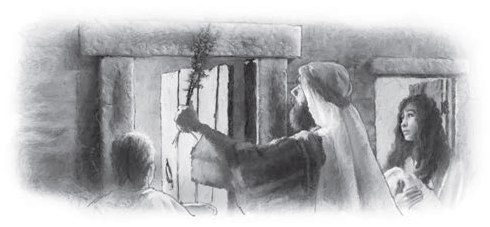
Before the execution of this sentence the Lord through Moses gave direction to the children of Israel concerning their departure from Egypt, and especially for their preservation from the coming judgment. Each family, alone or in connection with others, was to slay a lamb or a kid “without blemish,” and with a bunch of hyssop sprinkle its blood on “the two side posts and on the upper doorpost” of the house, that the destroying angel, coming at midnight, might not enter that dwelling. They were to eat the flesh roasted, with unleavened bread and bitter herbs, at night, as Moses said, “with your loins girded, your shoes on your feet, and your staff in your hand; and ye shall eat it in haste: it is the Lord’s
Passover.”—Patriarchs and Prophets, p. 274.
MONDAY July 28
Passover
Read Exodus 12:1–20. What specific instructions does God give to
Moses and Aaron before Israel leaves Egypt?
One would expect God to instruct Moses and Aaron about how to
organize the departure from Egypt: that is, how to make provisions
for the escape, especially for the elderly, mothers with small children,
animals, and so forth. Instead, God’s instruction is surprising: He tells
them how to celebrate the Passover. In other words, the focus is on
worshiping the Lord, who was going to redeem them. Everything else
would follow in due time.
Each family was to prepare a lamb, with nothing wasted. Everyone
had to eat his or her portion, and if the family could not consume the
entire lamb, they were to eat the meal together with another family.
Read Exodus 12:13, 14. What was the Lord going to do for them when
the final plague came? What does all this symbolize?
The Exodus was to be celebrated regularly each year, not merely
as a commemoration of a past event of what God had done for their
forefathers but also as the actualization of God’s liberating act for the
present generation. This was to be a fresh experience for each group.
Verses 12 and 13 explain the meaning of the Passover: the divine
judgment of destruction will “pass over” the Israelites; thus, they were
to commemorate “Passover.” This word is a combination of two words,
“pass” and “over,” because the destruction “passed over” the Israelite
homes on which the doorposts had been marked by the blood of the
lamb, the sign of life and salvation. In Hebrew, the name of Passover is
Pesach, from a verb that means “to pass over.”
The celebration of the Passover was to remind every Israelite of the
mighty and gracious acts of God on behalf of His people. This celebration
helped to secure their national identity and seal their religious convictions.
Why is it so important always to remember the good that God
has done to you in the past and to trust that He will do good for
you in the future, as well?
EGW Notes — MONDAY ↓
Monday, July 28
Passover
Here was a work required of the children of Israel, which they must perform on their part, to prove them and to show their faith by their works in the great deliverance God had been bringing about for them. In order to escape the great judgment of God which he was to bring upon the Egyptians, the token of blood must be seen upon their houses. And they were required to separate themselves and their children from the Egyptians, and gather them into their own houses, for if any of the Israelites were found in the houses of the Egyptians, they would fall by the hand of the destroying angel. They were also directed to keep the feast of the passover for an ordinance, that when their children should inquire what such service meant, they should relate to them their wonderful preservation in Egypt. That when the destroying angel went forth in the night to slay the first-born of man, and the first-born of beast, he passed over their houses, and not one of the Hebrews was slain that had the token of blood upon their door-posts. And the people bowed their heads and worshiped, grateful for this remarkable memorial given to preserve to their children the remembrance of God’s care for his people. There was quite a number of the Egyptians who were led to acknowledge, by the manifestations of the signs and wonders shown in Egypt, that the God of the Hebrews was the only true God. They entreated to be permitted to come to the houses of the Israelites with their families, upon that fearful night when the angel of God should slay the first-born of the Egyptians. They were convinced that their gods whom they had worshiped were without knowledge, and had no power to save or to destroy. And they pledged themselves to henceforth choose the God of Israel as their God. They decided to leave Egypt, and go with the children of Israel to worship their God. The Israelites welcomed the believing Egyptians to their
houses.—Spiritual Gifts, vol. 3, p. 223.
When the children of Israel were slaves in Egypt, the Lord sent Moses to set them free. He bade Moses go to Pharaoh, king of Egypt, and say:
“Thus saith the Lord, Israel is My son, even My firstborn: and I say unto thee, Let My son go, that he may serve Me: and if thou refuse to let him go, behold, I will slay thy son, even thy firstborn.” Exodus 4:22, 23.
Moses carried this message to the king. But Pharaoh’s answer was, “Who is the Lord, that I should obey His voice to let Israel go? I know not the Lord, neither will I let Israel go.” Exodus 5:2.
Then the Lord sent fearful plagues upon the Egyptians. The last of these plagues was the slaying of the first-born son of every family, from that of the king to the lowliest in the land.
The Lord told Moses that every family of the Israelites must kill a lamb, and put some of the blood upon the door-posts of their dwellings.
This was a sign, that the angel of death might pass over all the houses of the Israelites, and destroy none but the proud and cruel Egyptians.
This blood of the “Passover” represented to the Jews the blood of Christ. For in due time, God would give His dear Son to be slain as the lamb had been slain; so that all who should believe in Him might be saved from everlasting death. Christ is called our Passover. (1 Corinthians 5:7.) By His blood, through faith, we are redeemed. (Ephesians
1:7.)—The Story of Jesus, pp. 17, 18.
TUESDAY July 29
Pesach
Read Exodus 12:17–23. What role does blood play in the celebration
of this new festival?
The blood of the sacrificed animal is a key element in this celebration.
Those who participated in this feast had put the blood of the slain
lamb on the doorframes of their houses. In this way, they demonstrated
their faith in God, believing that He would deliver them from what
those not covered by the blood would face.
What a powerful expression of the gospel!
The Passover lamb had to be without blemish because it pointed
to Jesus Christ, “ ‘the Lamb of God who takes away the sin of the
world!’ ” (John 1:29, NKJV). The animal’s blood played a crucial role:
it symbolized protection and was the sign of life at a time of death.
“ ‘ “Now the blood shall be a sign for you on the houses where you
are. And when I see the blood, I will pass over you; and the plague shall
not be on you to destroy you when I strike the land of Egypt” ’ ” (Exod.
12:13, NKJV).
The whole gospel was associated with the celebration of the Passover
because it pointed not only to freedom from slavery and going to the
Promised Land but to Jesus Christ’s sacrifice for our sins and His
merits
applied to all who are covered by His blood.
Centuries later as Paul looked back on this celebration, he wrote:
“Therefore purge out the old leaven, that you may be a new lump,
since you truly are unleavened. For indeed Christ, our Passover, was
sacrificed for us” (1 Cor. 5:7, NKJV).
Yeast, or leaven, was used to prepare dough of various kinds. When
it is first mentioned in the Bible, it is in connection with the preparation
of the unleavened bread on the eve of the Israelites’ departure from
Egypt. Yeast also had to be removed from their homes (Exod. 12:8,
15–20; Exod. 13:3–7). In this particular context, yeast was a symbol of
sin (1 Cor. 5:6–8); therefore, it was not to be used during the Passover
festival for a week.
The unleavened bread is a symbol of the sinless Messiah, who overcame
all temptations and gave His life for us (John 1:29, 1 Cor. 5:7,
Heb. 4:15). A bunch of “hyssop,” which was dipped in the blood, symbolized
God’s purifying grace (Ps. 51:7). In short, all through Pesach,
the redeeming work of Jesus is revealed.
What does the fact that it took the blood of Jesus, God Himself,
to atone for sin to teach us about how bad sin really is?
EGW Notes — TUESDAY ↓
Tuesday, July 29
Pesach
In commemoration of this great deliverance a feast was to be observed yearly by the people of Israel in all future generations. . . .
The hyssop used in sprinkling the blood was the symbol of purification, being thus employed in the cleansing of the leper and of those defiled by contact with the dead. In the psalmist’s prayer also its significance is seen: “Purge me with hyssop, and I shall be clean: wash me, and I shall be whiter than snow.” Psalm 51:7.
The lamb was to be prepared whole, not a bone of it being broken: so not a bone was to be broken of the Lamb of God, who was to die for us. John 19:36. Thus was also represented the completeness of Christ’s sacrifice.
The flesh was to be eaten. It is not enough even that we believe on Christ for the forgiveness of sin; we must by faith be constantly receiving spiritual strength and nourishment from Him through His word. Said Christ, “Except ye eat the flesh of the Son of man, and drink His blood, ye have no life in you. Whoso eateth My flesh, and drinketh My blood, hath eternal life.” John 6:53, 54. And to explain His meaning He said, “The words that I speak unto you, they are spirit, and they are life.” Verse 63. Jesus accepted His Father’s law, wrought out its principles in His life, manifested its spirit, and showed its beneficent power in the heart. Says John, “The Word was made flesh and dwelt among us, (and we beheld His glory, the glory as of the only begotten of the Father,) full of grace and truth.” John 1:14. . . .
The lamb was to be eaten with bitter herbs, as pointing back to the bitterness of the bondage in Egypt. So when we feed upon Christ, it should be with contrition of heart, because of our sins. The use of unleavened bread also was significant. It was expressly enjoined in the law of the Passover, and as strictly observed by the Jews in their practice, that no leaven should be found in their houses during the feast. In like manner the leaven of sin must be put away from all who would receive life and nourishment from Christ. So Paul writes to the Corinthian church, “Purge out therefore the old leaven, that ye may be a new lump. . . . For even Christ our Passover is sacrificed for us: therefore let us keep the feast, not with old leaven, neither with the leaven of malice and wickedness; but with the unleavened bread of sincerity and truth.” 1 Corinthians 5:7,
8.—Patriarchs and Prophets, pp. 277, 278.
WEDNESDAY July 30
Passing the Torch
The psalmist states how our children can know God and His loving
care: “One generation shall commend your works to another, and shall
declare your mighty acts” (Ps. 145:4, ESV). One family should speak
to another family about God, about His marvelous deeds, and about
His teachings, all in order to pass biblical knowledge on to another
generation.
Read Exodus 12:24–28. What important point was being made here?
Parents were the first teachers in Israel and were to recount the story
of the Exodus to their children. It was not to be told as a past historical
event only but to be presented as their own experience, even though
it happened a long time ago. By celebrating this festival, they were to
identify with their forefathers, and the history was to be relived and
actualized. The father would say: “I was in Egypt, I saw the defeat of
the Egyptian gods and the plagues on Egypt, and I was set free.” In
the book of Exodus, it is twice underlined how parents should answer
their children’s questions regarding the Passover (see Deut. 6:6–8 and
Exodus 13:14–16).
It is worthwhile to notice that the Israelites were still in Egypt when
told to celebrate their liberation from Egypt. The whole celebration,
then, was an act of faith. After receiving their directions, “the people
bowed down and worshiped” (Exod. 12:27, NIV) their Redeemer, and
then they followed the Passover instructions.
In the book of Deuteronomy, the Israelites are reminded to tell their
story in such a way that they can internalize it as their own journey.
Notice the collective tone of this account as well as the stress on the
present experience: “ ‘My father was a wandering Aramean, and he
went down into Egypt with a few people and lived there and became
a great nation, powerful and numerous. But the Egyptians mistreated
us and made us suffer, subjecting us to harsh labor. Then we cried out
to the Lord, the God of our ancestors, and the Lord heard our voice
and saw our misery, toil and oppression. So the Lord brought us out
of Egypt with a mighty hand and an outstretched arm, with great terror
and with signs and wonders. He brought us to this place and gave us
this land, a land flowing with milk and honey’ ” (Deut. 26:5-9, NIV).
Also, by recounting and retelling the story of Passover (or any events
in sacred history) to their children, parents would be greatly helped in
remembering what God had done for them and for the people. Telling
it was as much for the speaker as for the hearers.
EGW Notes — WEDNESDAY ↓
Wednesday, July 30
Passing the Torch
The Lord gave Moses special directions for the children of Israel in regard to what they must do to preserve themselves and their families from the fearful plague that He was about to send upon the Egyptians. Moses was also to give his people instructions in regard to their leaving Egypt. On that night, so terrible to the Egyptians and so glorious to the people of God, the solemn ordinance of the Passover was instituted. By the divine command, each family, alone or in connection with others, was to slay a lamb or a goat “without blemish,” and with a bunch of hyssop sprinkle its blood on “the two side posts, and on the upper door post” of their houses, as a token, that the destroying angel, coming at midnight, might not enter that dwelling. They were to eat the flesh roasted, with bitter herbs, at night, as Moses said, “with your loins girded, your shoes on your feet, and your staff in your hand; and ye shall eat it in haste: it is the Lord’s passover.” This name was given in memory of the angel’s passing by their dwellings; and such a feast was to be observed as a memorial by the people of Israel in all future
generations.—From the Heart, July 29, 222.
Not one act in the life of Christ was unimportant. Every event of his life was for the benefit of his followers in future time. This circumstance of the tarry of Christ in Jerusalem teaches an important lesson to those who should believe on him. Many had come a great distance to keep the passover, instituted that the Hebrews might keep in memory their wonderful deliverance from Egypt. This ordinance was designed to call their minds from their world-loving interests, and from their cares and anxieties in relation to temporal concerns, and to review the works of God. They were to call to mind his miracles, his mercies and loving-kindness, to them, that their love and reverence for him might increase, and lead them to ever look to him, and trust in him in all their trials, and not turn to other gods.
The observance of the passover possessed a mournful interest to the Son of God. He saw in the slain lamb a symbol of his own death. The people who celebrated this ordinance were instructed to associate the slaying of the lamb with the future death of the Son of God. The blood, marking the door-posts of their houses, was the symbol of the blood of Christ, which was to be efficacious for the believing sinner, in cleansing him from sin, and sheltering him from the wrath of God which was to come upon the impenitent and unbelieving world, as the wrath of God fell upon the Egyptians. But none could be benefited by this special provision made by God for the salvation of man unless they should perform the work the Lord left them to do. They had a part to act themselves, and by their acts to manifest their faith in the provision made for their salvation.—“The Life of Christ,”
Advent Review and Sabbath Herald, December 31, 1872, par. 11, 12.
THURSDAY July 31
The Divine Judgment
Read Exodus 12:29, 30 on how God struck down the firstborn in
Egypt. Why did God focus on the firstborn? (See also Heb. 11:28.)
The last Egyptian plague fell on the firstborn. It was a divine judgment
on all the gods of Egypt and upon all the families who worshiped
these false gods, which were worthless idols that reflected the people’s
own passions, desires, and fears.
As the earlier plagues had shown, these idols were unable to save
the people. Their worthlessness was even more apparent now, during
the tenth plague, which brought, by far, the greatest consequences on
the Egyptians.
“Throughout the vast realm of Egypt the pride of every household
had been laid low. The shrieks and wails of the mourners filled the air.
King and courtiers, with blanched faces and trembling limbs, stood
aghast at the overmastering horror.”—Ellen G. White, Patriarchs and
Prophets, p. 280.
Pharaoh represented the ultimate power and god of Egypt, and his
firstborn son was considered a son of a god. Isis was a goddess protecting
children; Heqet was a goddess attending women at childbirth;
and Min was a god of reproduction. Besides these, there were several
Egyptian gods of fertility. All these gods were powerless in comparison
to the living Lord. Moses says: “ ‘Who is like you, O Lord,
among the gods? Who is like you, majestic in holiness, awesome in
glorious deeds, doing wonders?’ ” (Exod. 15:11, ESV). Jethro later
testified: “ ‘Now I know that the Lord is greater than all other gods,
for he did this to those who had treated Israel arrogantly’ ” (Exod.
18:11, NIV).
According to Exodus 1, the Egyptians had killed newborn sons of
Israel on the command of Pharaoh to weaken the Israelites and to subdue
and humiliate them. Now God’s punishment strikes the firstborn
sons of Egypt. What people sow, they reap.
Our decisions and actual behavior bring consequences. And the painful
truth, which we all have experienced, is that we alone don’t suffer
from the consequences of our wrong actions. Others, sometimes many
others, even innocent others, suffer, as well. Such is the nature of sin.
In what ways have you suffered from others’ sins? Or, what are
ways others have suffered from your sins? What is our only hope?
EGW Notes — THURSDAY ↓
Thursday, July 31
The Divine Judgment
The Lord gave special directions to the Hebrews, for each family to slay a lamb and sprinkle the blood upon their door-posts, that when the destroying angel should go forth upon his errand of death, the blood upon the post of the door should be to them a sign that those who were within the house were the worshipers of the true God. The angel of death passed over the houses thus designated. Upon that eventful night the Hebrews were directed to be prepared for their journey. The Lord directed them in regard to their eating the passover lamb. “And thus shall ye eat it; with your loins girded, your shoes on your feet, and your staff in your hand; and ye shall eat it in haste; it is the Lord’s passover.”
The Lord did not send any plague upon Egypt before giving them timely warning. Moses and Aaron, under God’s direction, came to the king with their message: “Thus saith the Lord, About midnight will I go out into the midst of Egypt, and all the first-born in the midst of Egypt shall die, from the first-born of Pharaoh that sitteth upon the throne, even unto the first-born of the maid servant that is behind the mill; and all the first-born of beasts. But against any of the children of Israel shall not a dog move his tongue, against man and beast, that ye may know that the Lord doth put a difference between the Egyptians and Israel.” Pharaoh would not yield his stubborn will to the requirement of God. He hardened his heart against the Hebrews and refused them their liberty.
About midnight every Egyptian household was aroused from their sleep by the cry of pain. They feared they were all to die. They remembered when the cry of distress and mourning was heard from the Hebrews because of the inhuman decree of a cruel king to slay all their male infants as soon as they were born. The Egyptians could not see the avenging angel, who entered every house and dealt the death blow, but they knew that it was the Hebrew’s God who was causing them to suffer the same distress they had made the Israelites to
suffer.—“The Life of Christ—No. 6,” Youth’s Instructor, May 1, 1873, par. 4–6.
The vast armies of Israel marched in glad triumph from Egypt, the scene of their long and cruel servitude. The Egyptians would not consent to release them until they had been signally warned by the judgments of God. The avenging angel had visited every house among the Egyptians and had stricken with death the first-born of every family. None had escaped, from the heir of Pharaoh to the eldest-born of the captive in his dungeon. The first-born of the cattle also were slain according to the mandate of the Lord. But the angel of death passed over the homes of the children of Israel and did not enter there.
Pharaoh, horror-stricken at the plagues that had befallen his people, called Moses and Aaron before him in the night and bade them depart from Egypt. He was anxious that they should go without delay; for he and his people feared that unless the curse of God was removed from them, the land would become a vast burial
ground.—Testimonies for the Church, vol. 4, pp. 20, 21.
FRIDAY August 1
Further Thought: Read Ellen G. White, “The Passover,” pp. 273–
280, in Patriarchs and Prophets.
“The Passover was to be both commemorative and typical, not only
pointing back to the deliverance from Egypt, but forward to the greater
deliverance which Christ was to accomplish in freeing His people
from the bondage of sin. The sacrificial lamb represents ‘the Lamb of
God,’ in whom is our only hope of salvation. Says the apostle, ‘Christ
our Passover is sacrificed for us.’ 1 Corinthians 5:7. It was not enough
that the paschal lamb be slain; its blood must be sprinkled upon the
doorposts; so the merits of Christ's blood must be applied to the soul.
We must believe, not only that He died for the world, but that He died
for us individually. We must appropriate to ourselves the virtue of the
atoning sacrifice.”—Ellen G. White, Patriarchs and Prophets, p. 277.
To this day, observant Jewish families around the world celebrate
Passover, Pesach. They have what they call a “Passover Seder” (“Seder”
means “order/arrangement”) during which they recount the Exodus and
then enjoy a special meal as a family. Amazing that this has been kept
since, literally, the time of the Exodus! Only the seventh-day Sabbath,
which observant Jews keep as well, goes back even farther into antiquity.
Discussion Questions:
-
How can we understand the “fairness” of the Lord in striking
dead the firstborn, many of whom were surely “innocent”? How
can we harmonize this with the powerful reality of God’s love?
Think, too, of the Flood. How do we understand this?
-
What is the meaning of the symbolic saying that believers are
covered by the blood of Jesus and that His blood cleanses them
from all their iniquities?
-
Read the following words: “The followers of Christ must be
partakers of His experience. They must receive and assimilate the
word of God so that it shall become the motive power of life and
action. By the power of Christ they must be changed into His likeness,
and reflect the divine attributes. . . . The spirit and work of
Christ must become the spirit and work of His disciples.”—Ellen
G. White, Patriarchs and Prophets, p. 278. How do we allow Christ
to do in us what is written here?
EGW Notes — FRIDAY ↓
Friday, August 1
For Further Reading
“The Passover,” Signs of the Times, March 25, 1880, par. 1–9;
“The Passover Visit,” in The Desire of Ages, pp. 75–78.
INSIDE STORY
Swapping Soccer for God
By Andrew McChesney
Silva Langa, a high school student in Mozambique, loved soccer. The
sport was his god, and he played whenever he could. He was a skillful
player and dreamed about a big-league career.
Then a friend surprised him by saying, bluntly, “You have many good
qualities, but you lack God.” Silva’s surprise grew when the friend, Hodes,
invited him to church on Saturday. Silva had never heard of a church that
worshiped on Saturdays. In addition, Saturday wasn’t a good day for him
to go to church. It was the day he most often played soccer matches.
Hodes, however, was a good friend, and Silva accompanied him to church
on the next Saturday that he was free. Silva was surprised again. Church
members showered him with love and affection. The hymns touched his
heart. He studied the Bible, and he gave his heart to Jesus in baptism.
Many of Silva’s relatives and friends couldn’t understand why he had
stopped playing soccer on Saturdays.
“You have a crazy faith,” said one.
“Why would anyone go to church instead of a soccer game?” said
another.
Silva explained his faith as best as he could.
His parents became worried when Silva skipped university entrance
exams on a Saturday. They questioned his mental health, asking him why he
was willing to risk his future for the Sabbath. It was a severe trial for Silva,
but he decided to adopt the courage of Peter and other apostles and declare
like them, “We ought to obey God rather than men” (Acts 5:29, NKJV).
The dismay of his parents grew when the school called to ask why he
wasn’t going to Friday night classes. Several relatives pleaded with local
Adventist leaders to tell Silva to study on Friday nights. The leaders did
not offer a Bible study on the Sabbath. Instead, they offered assurances
that God would not leave the teen and that he would graduate from high
school.
Before long, Silva was able to transfer to an Adventist high school,
where he no longer faced Sabbath conflicts. He graduated from the high
school.
Today, Silva is an entrepreneur who has no regrets about giving up his
god of soccer for the God of heaven. His life of faithfulness has led two of
his sisters and other people to baptism.
“God has blessed my life,” Silva said. “I thank God that today my family
respects my beliefs.”
Pray for the gospel to be proclaimed in Mozambique and other countries in the
Southern Africa-Indian Ocean Division, which will receive this quarter’s Thirteenth
Sabbath Offering.
Provided by the General Conference Office of Adventist Mission, which uses Sabbath School
mission offerings to spread the gospel worldwide. Read new stories daily at
AdventistMission.org.