LESSON 7 *May 10–16
Sabbath Afternoon
Read for This Week’s Study: Isa. 6:6–8, Gen. 3:21–24, Ezek. 1:4–14, Rev. 4:1–11, Num. 2:3–25, Isa. 14:12–14.
Memory Text: “Also I heard the voice of the Lord, saying: ‘Whom shall I send, and who will go for Us?’ Then I said, ‘Here am I! Send me’ ” (Isaiah 6:8, NKJV).
God's right to rule the universe is founded upon His position as the Creator of all things (Rev. 4:11) and also upon His character. It is in discovering God’s righteous character that we begin to understand how and why sinful human beings fall short of the glory of God (Rom. 3:23).
This week, we move further into the vision of the throne room and consider how the human race relates to a holy God and how the sacrifice of Christ restores us and brings us close to the throne. God plans to restore us, not just as individuals but also as a race, so that we once again reveal His glory to the rest of creation. By searching through the rest of the Bible, we can find important clues that help us understand and begin to appreciate the high calling that God has extended to us, a race of forgiven and redeemed sinners.
Human rebellion, ultimately and forever, will be ended. And, more than that, God’s loving character, His self-denying and self-sacrificing character, will shine even brighter than it did in His original design for humanity. Though God never intended for humanity to fall, through the Cross, God’s loving character has been put on display in a remarkable way.
* Study this week’s lesson to prepare for Sabbath, May 17.
EGW Notes — SATURDAY ↓
Sabbath Afternoon, May 10
Lesson 7 - Foundations for Prophecy
Ever since the fall of Adam Christ had been committing the seed of the word to His chosen servants, to be sown in human hearts. And an unseen agency, even an omnipotent power, had worked silently but effectually to produce the harvest. The dew and rain and sunshine of God’s grace had been given, to refresh and nourish the seed of truth. Christ was about to water the seed with His own blood. His disciples were privileged to be laborers together with God. They were coworkers with Christ and with the holy men of old. By the outpouring of the Holy Spirit at Pentecost, thousands were to be converted in a day. This was the result of Christ’s sowing, the harvest of His
work.—The Desire of Ages, p. 192.
The whole universe is under the control of the Prince of life. . . . He paid the ransom money for the whole world. All may be saved through Him. He calls upon us to obey, believe, receive, and live. He would gather together a church embracing the whole human family, if all would leave the black banner of rebellion and place themselves under His banner. Those who believe on Him, He will present to God as loyal subjects. He is our Mediator as well as our Redeemer. He will defend His chosen followers against Satan’s power and subdue all their enemies. . . .
Christ desired His disciples to understand that He would not leave them orphans. . . . He was about to die, but He desired them to realize that He would live again. And although after His ascension He would be absent from them, yet by faith they might see and know Him, and He would have the same loving interest in them that He had while with them.—“Coworkers with Christ,” in
From the Heart, p. 252.
There is no comforter like Christ, so tender and so true. He is touched with the feeling of our infirmities. His Spirit speaks to the heart. Circumstances may separate us from our friends; the broad, restless ocean may roll between us and them. Though their sincere friendship may still exist, they may be unable to demonstrate it by doing for us that which would be gratefully received. But no circumstances, no distance, can separate us from the heavenly Comforter. Wherever we are, wherever we may go, he is always there, one given in Christ’s place, to act in his stead. He is always at our right hand, to speak soothing, gentle words; to support, sustain, uphold, and cheer. The influence of the Holy Spirit is the life of Christ in the soul. This Spirit works in and through every one who receives Christ. Those who know the indwelling of this Spirit reveal its fruit,—love, joy, peace, long-suffering, gentleness, goodness, faith.—“Words of Comfort—No. 2,”
Advent Review and Sabbath Herald, October 26, 1897, par. 15.
SUNDAY May 11
Here I Am, Send Me
Years ago, a church decided to renovate an outdated basement to create
a new fellowship hall. One of the first things they did was to install
new lights, believing that they would make the space seem more beautiful.
Once they were installed, however, the space looked even worse,
because bright lights have a way of revealing flaws.
Isaiah’s stunning vision of God’s throne left him painfully aware of
his shortcomings. “ ‘Woe is me,’ ” he lamented, “ ‘for I am undone!
Because I am a man of unclean lips, and I dwell in the midst of a people
of unclean lips; for my eyes have seen the King, the Lord of hosts’ ”
(Isa. 6:5, NKJV). We would feel the same if we were suddenly escorted
into the presence of the Lord. The light is bright enough to remove all
of our excuses. In God’s presence, we sense that we are lost. Isaiah was
in for the surprise of a lifetime.
Read Isaiah 6:6–8. Isaiah knew that sin means that we are “undone.”
The wages of sin is death. But instead of leaving us to the consequences
of sin, a God of love pulls us closer. What was the outcome
of this meeting, and why is it important?
* Your notes will not be saved!
Isaiah was purged of his sin when a seraph took a coal from the altar
and touched his mouth with it. This was likely the altar of incense,
where intercession was made by and for God’s people (see Rev. 8:3, 4).
His sins were forgiven, and he was now considered fit to stand in God’s
presence—but, more than that, he was also commissioned to represent
God to the world.
Interestingly enough, the word “seraph” means “the burning one.”
Notice Jesus’ description of John the Baptist’s ministry in John
5:35—“ ‘He was the burning and shining lamp, and you were willing for
a time to rejoice in his light’ ” (NKJV). Though, of course, John himself
was a sinner in need of grace and salvation, his ministry pointed to the
only One who could bring grace and salvation.
Jesus came as the perfect representation of the Father’s glory—and
God sent a prophet, a sinner, who performed a similar task as one of
heaven’s seraphim.
Only after Isaiah knew that his sin was purged, did he say, “ ‘Here
am I! Send me’ ” (Isa. 6:8, NKJV). How can each one of us, our
sins purged by the blood of Jesus, respond as Isaiah did here?
EGW Notes — SUNDAY ↓
Sunday, May 11
Here I Am, Send Me
As Isaiah beheld this revelation of the glory and majesty of his Lord, he was overwhelmed with a sense of the purity and holiness of God. How sharp the contrast between the matchless perfection of his Creator, and the sinful course of those who, with himself, had long been numbered among the chosen people of Israel and Judah! “Woe is me!” he cried; “for I am undone; because I am a man of unclean lips, and I dwell in the midst of a people of unclean lips: for mine eyes have seen the King, the Lord of hosts.” [Isaiah 6:5]. Standing, as it were, in the full light of the divine presence within the inner sanctuary, he realized that if left to his own imperfection and inefficiency, he would be utterly unable to accomplish the mission to which he had been called. But a seraph was sent to relieve him of his distress and to fit him for his great mission. A living coal from the altar was laid upon his lips, with the words, “Lo, this hath touched thy lips; and thine iniquity is taken away, and thy sin purged.” Then the voice of God was heard saying, “Whom shall I send, and who will go for Us?” and Isaiah responded, “Here am I; send me.” Verses 7,
8.—Prophets and Kings, pp. 307, 308.
God has His workmen in every age. The call of the hour is answered by the human agencies. Thus it will be when the divine voice cries, “Whom shall I send? and who will go for us?” The response will come, “Here am I, send me.” The Lord imparts a fitness for the work to every man and woman who will co-operate with divine power. A great work is to be done in our world, and human agencies will surely respond to the demand. And all the requisite talent, courage, perseverance, faith, and tact will come as they put the armor on. The world must hear the warning. When the call comes, “Whom shall I send, and who will go for us?” send back the answer clear and distinct, “Here am I; send me.”—“An Appeal,”
The Bible Echo, September 18, 1899, par. 17.
Isaiah had a wonderful view of God’s glory. He saw the manifestation of God’s power, and after beholding His majesty, a message came to him to go and do a certain work. He felt wholly unworthy for the work. . . . [W]hen he beheld the inexpressible majesty of God, he said, “I am undone; because I am a man of unclean lips, and I dwell in the midst of a people of unclean lips; for mine eyes have seen the King, the Lord of hosts. Then flew one of the seraphim unto me, having a living coal in his hands, which he had taken with the tongs from off the altar, and he laid it upon my mouth, and said, Lo, this hath touched thy lips; and thine iniquity is taken away, and thy sin purged.” This is the work that as individuals we need to have done for us. We want the living coal from off the altar placed upon our lips. We want to hear the word spoken, “Thine iniquity is taken away, and thy sin purged”—“Constant Attainment Essential to Christian Life,”
Advent Review and Sabbath Herald, June 4, 1889, par. 10.
MONDAY May 12
The Two Cherubim
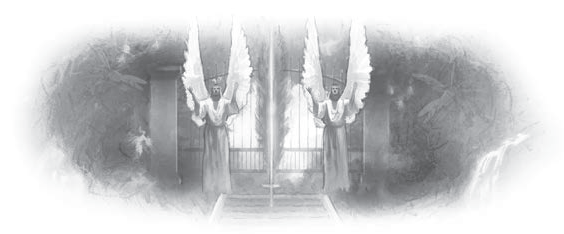
As soon as our first parents were expelled from the Garden, God
offered the hope of Messiah (Gen. 3:15). Then He established a powerful
symbol at the gates of Eden: two cherubim with a brilliant flashing
light between them. It should not be lost on us that this scene so closely
resembles the ark of the covenant, a symbol of God’s throne (Exod.
25:18).
Read Genesis 3:21–24. What job were the cherubim tasked with—and
why?
While the cherubim were certainly given the responsibility to keep
sinners from accessing the tree of life (Gen. 3:22), they also were a
symbol of hope, of promise, that one day humans would be restored to
Paradise. “The Garden of Eden remained upon the earth long after man
had become an outcast from its pleasant paths. The fallen race was long
permitted to gaze upon the home of innocence, their entrance barred
only by the watching angels. At the cherubim-guarded gate of Paradise
the divine glory was revealed. Hither came Adam and his sons to worship
God. Here they renewed their vows of obedience to that law the
transgression of which had banished them from Eden. . . . But in the
final restitution, when there shall be ‘a new heaven and a new earth’
(Revelation 21:1), it is to be restored more gloriously adorned than at
the beginning.”—Ellen G. White, Patriarchs and Prophets, p. 62.
The wording in Genesis 3:24 is also interesting: the Bible indicates
that God “placed” the cherubim to the east of Eden, and the original
Hebrew word used is shakan, the root word for the sacred “tabernacle”
(see Exod. 25:9, Num. 3:26), where the presence of God dwelt among
His people. Though the common term Shekinah, for the presence of
God, does not appear in the Bible, it, too, is based on this word often
translated “tabernacle.” A literal translation of shakan could read, “God
tabernacled cherubim at the east of the Garden of Eden.”
In the Bible, cherubim are associated with the presence of God (see
1 Chron. 13:6, Ps. 80:1, and Isa. 37:16), in particular with His throne,
which is the place where His name is proclaimed. We should not fail to
notice that the 24 elders who attend God’s throne in Revelation 4 and 5
sing His praises and declare His right to rule as the One who created all
things (Rev. 4:11). This can help us understand the throne room scene
and our role as forgiven sinners in relationship to our Maker.
EGW Notes — MONDAY ↓
Monday, May 12
The Two Cherubim
The glorious memorial of God’s wonderful power is soon to be restored to its rightful place. Then paradise lost will be paradise restored. God’s plan for the redemption of man will be complete. The Son of Man will bestow upon the righteous the crown of everlasting life, and they shall “serve him day and night in his temple; and he that sitteth on the throne shall dwell among them. They shall hunger no more, neither thirst any more; neither shall the sun light on them, nor any heat. For the Lamb which is in the midst of the throne shall feed them, and shall lead them unto living fountains of waters: and God shall wipe away all tears from their eyes.”—“The First and Second Advent,”
Advent Review and Sabbath Herald, September 5, 1899, par. 15.
As the ransomed ones are welcomed to the City of God, there rings out upon the air an exultant cry of adoration. The two Adams are about to meet. . . . As Adam discerns the prints of the cruel nails, he does not fall upon the bosom of his Lord, but in humiliation casts himself at His feet, crying: “Worthy, worthy is the Lamb that was slain!” Tenderly the Saviour lifts him up and bids him look once more upon the Eden home from which he has so long been exiled.
After his expulsion from Eden, Adam’s life on earth was filled with sorrow. Every dying leaf, every victim of sacrifice, every blight upon the fair face of nature, every stain upon man’s purity, was a fresh reminder of his sin. Terrible was the agony of remorse as he beheld iniquity abounding, and, in answer to his warnings, met the reproaches cast upon himself as the cause of sin. . . . Faithfully did he repent of his sin and trust in the merits of the promised Saviour, and he died in the hope of a resurrection. The Son of God redeemed man’s failure and fall; and now, through the work of the atonement, Adam is reinstated in his first dominion.
Transported with joy, he beholds the trees that were once his delight—the very trees whose fruit he himself had gathered in the days of his innocence and joy. He sees the vines that his own hands have trained, the very flowers that he once loved to care for. His mind grasps the reality of the scene; he comprehends that this is indeed Eden restored, more lovely now than when he was banished from it. The Saviour leads him to the tree of life and plucks the glorious fruit and bids him eat. He looks about him and beholds a multitude of his family redeemed, standing in the Paradise of God. Then he casts his glittering crown at the feet of Jesus and, falling upon His breast, embraces the Redeemer. He touches the golden harp, and the vaults of heaven echo the triumphant song: “Worthy, worthy, worthy is the Lamb that was slain, and lives again!” The family of Adam take up the strain and cast their crowns at the Saviour’s feet as they bow before Him in
adoration.—The Great Controversy, pp. 647, 648.
TUESDAY May 13
Like Burning Coals of Fire
Cherubim, either as living beings (Ezek. 10:8) or the gold symbols
of them (Exod. 25:18), appear all through the Old Testament. They are
often depicted as standing immediately next to God’s throne, radiating
His glory to the universe. Cherubim also are embroidered into the
curtain before the Holy of Holies (Exod. 26:1). In the book of Psalms,
God’s supreme power over creation is poetically pictured as God being
borne through the air by cherubim (Ps. 18:10). God commanded that
the ark of the covenant be topped by two solid gold cherubim with their
wings extended toward one another (Exod. 25:18–20).
Read Ezekiel 1:4–14. What similarities do you see between this passage
and the scenes depicted in Isaiah 6:1–6 and Revelation 4:1–11?
Ezekiel is presented with an impressive display of God’s power. It is
a confusing scene to begin with, matching the predicament that God’s
people found themselves living with at the moment: the chosen people
not in the land of promise but in Babylonian captivity. As Ezekiel
studies the scene placed before him, he looks up and sees God’s throne
above it all.
Notice the important similarities with other “throne” visions. The living
creatures that Ezekiel witnesses have the same faces as the living
creatures in John’s vision: a lion, an eagle, an ox, and a man.
The mysterious creatures with four faces are not specifically named
in Ezekiel’s initial description; later, in another throne room scene (see
Ezek. 10:1–21), they are called “cherubim,” and we also find the burning
coals from Isaiah’s vision of the seraphs. They share the faces of the
living creatures mentioned in John’s vision.
Whenever we see God’s throne—whether in the typical ark of the
covenant, which served as God’s meeting place with Moses (Exod.
25:22), or the breathtaking visions of the prophets—the cherubim are
always there. They are intimately tied to the throne of God. All of God’s
creatures were designed to reflect His glory—whether we are talking
about the human race made in His image or the angelic beings who are
posted immediately next to His glorious throne.
Holy, holy, holy is the Lord God Almighty. How do you measure up
in contrast to the holiness that Ezekiel witnesses here? What does
your answer tell you about your need of the gospel?
EGW Notes — TUESDAY ↓
Tuesday, May 13
Like Burning Coals of Fire
In the world to come, Christ will lead the redeemed beside the river of life, and will teach them wonderful lessons of truth. He will unfold to them the mysteries of nature. They will see that a Master-Hand holds the worlds in position. They will behold the skill displayed by the great Artist in coloring the flowers of the field, and will learn of the purposes of the merciful Father, who dispenses every ray of light, and with the holy angels the redeemed will acknowledge in songs of grateful praise God’s supreme love to an unthankful world. Then it will be understood that “God so loved the world, that he gave his only begotten Son, that whosoever believeth in him should not perish, but have everlasting life.”—“Our Need of the Holy Spirit,”
Advent Review and Sabbath Herald, January 3, 1907, par. 13.
From eternal ages it was God’s purpose that every created being, from the bright and holy seraph to man, should be a temple for the indwelling of the Creator. Because of sin, humanity ceased to be a temple for God. Darkened and defiled by evil, the heart of man no longer revealed the glory of the Divine One. But by the incarnation of the Son of God, the purpose of Heaven is fulfilled. God dwells in humanity, and through saving grace the heart of man becomes again His
temple.—The Desire of Ages, p. 161.
Upon the banks of the river Chebar, Ezekiel beheld a whirlwind seeming to come from the north, “a great cloud, and a fire infolding itself, and a brightness was about it, and out of the midst thereof as the color of amber.” A number of wheels intersecting one another were moved by four living beings. High above all these “was the likeness of a throne, as the appearance of a sapphire stone; and upon the likeness of the throne was the likeness as the appearance of a man above upon it.” “And there appeared in the cherubims the form of a man’s hand under their wings.” Ezekiel 1:4, 26; 10:8.
The wheels were so complicated in arrangement that at first sight they appeared to be in confusion; yet they moved in perfect harmony. Heavenly beings, sustained and guided by the hand beneath the wings of the cherubim, were impelling those wheels; above them, upon the sapphire throne, was the Eternal One; and round about the throne was a rainbow, the emblem of divine mercy.
As the wheel-like complications were under the guidance of the hand beneath the wings of the cherubim, so the complicated play of human events is under divine control. Amidst the strife and tumult of nations, He that sitteth above the cherubim still guides the affairs of this
earth.—The Truth About Angels, pp. 137, 138.
WEDNESDAY May 14
God Among His People
Following the leading of God’s presence in the cloud, the Israelites
would stop in their journey to the Promised Land, set up the tabernacle,
and then the tribes would pitch their camps around it—three tribes on
each side. The Presence of God would descend into the Most Holy
Place and take up residence in the midst of His people.
There was one dominant tribe on each of the four sides of the tabernacle.
According to Numbers 2, who were these four dominant tribes?
Num. 2:3 (East):
Num. 2:10 (South):
Num. 2:18 (West):
Num. 2:25 (North):
Notice that each dominant tribe flew its own “standard,” or special flag,
to designate who they were. While the Scriptures are not explicit in describing
what was on each flag, there is an interesting tradition—loosely based
on the tribal characteristics described in Genesis 49 and Deuteronomy
33—that assigns one of the four faces to each of the four compass points.
“According to rabbinical tradition, the standard of Judah bore the figure
of a lion, that of Reuben the likeness of a man or of a man’s head, that of
Ephraim the figure of an ox, and that of Dan the figure of an eagle; so
that the four living creatures united in the cherubic forms described by
Ezekiel were represented upon these four standards.”—Carl Friedrich Keil
and Franz Delitzsch, Commentary on the Old Testament, (Peabody, MA:
Hendrickson, 2011), vol. 1, p. 660.
It is possible to read too much into tradition, of course, but it is
still interesting to compare this ancient tradition with the Bible’s
description of the New Jerusalem. An interesting pattern emerges:
there are gates representing three tribes on all four sides of the city
(Rev. 21:12, 13).
The descriptions of both the camp of Israel and the New Jerusalem
underscore one crucial fact: God intends to pull humanity close to
His throne. The book of Revelation teaches us that “the Lord God
Almighty and the Lamb are its temple” (Rev. 21:22, NKJV).
Of course, we don’t live in the camp of Israel. But how can we, in
our own lives now, draw close to the presence of God?
EGW Notes — WEDNESDAY ↓
Wednesday, May 14
God Among His People
God gave a clear and definite knowledge of his will to Israel by especial precepts, showing the duty of man to God and to his fellow-men. The worship due to God was clearly defined. A special system of rites and ceremonies was established, which would secure the remembrance of God among his people, and thereby serve as a hedge to guard and protect the ten commandments from violation. . . .
God’s people, whom he calls his peculiar treasure, were privileged with a two-fold system of law; the moral and the ceremonial. The one, pointing back to creation to keep in remembrance the living God who made the world, whose claims are binding upon all men in every dispensation, and which will exist through all time and eternity. The other, given because of man’s transgression of the moral law, the obedience to which consisted in sacrifices and offerings pointing to the future redemption. Each is clear and distinct from the other. From the creation the moral law was an essential part of God’s divine plan, and was as unchangeable as himself. The ceremonial law was to answer a particular purpose of Christ’s plan for the salvation of the race. The typical system of sacrifices and offerings was established that through these services the sinner might discern the great offering, Christ.—“The Law of God,”
Advent Review and Herald of the Sabbath, May 6, 1875, par. 3, 4.
The gift of Christ is the highest possible pledge of help in all our trouble and victory in all our conflicts. In Christ is the strength of His people; for all power is given unto Him in heaven and in earth. Let us as a people who have had great light remember that Christ sits among His people as a refiner and purifier of silver. He is continually cleansing the hearts of those who engage in His service as workers together with God. He will work through every soul. He is continually cleansing the hearts of those who are willing to be cleansed, separating the pure from the
impure.—Letter 195, 1899, par. 12.
A period of about half a year was occupied in the building of the tabernacle. When it was completed, Moses examined all the work of the builders, comparing it with the pattern shown him in the mount and the directions he had received from God. “As the Lord had commanded, even so had they done it: and Moses blessed them.” With eager interest the multitudes of Israel crowded around to look upon the sacred structure. While they were contemplating the scene with reverent satisfaction, the pillar of cloud floated over the sanctuary and, descending, enveloped it. “And the glory of the Lord filled the tabernacle.” There was a revealing of the divine majesty, and for a time even Moses could not enter. With deep emotion the people beheld the token that the work of their hands was accepted. There were no loud demonstrations of rejoicing. A solemn awe rested upon all. But the gladness of their hearts welled up in tears of joy, and they murmured low, earnest words of gratitude that God had condescended to abide with
them.—Patriarchs and Prophets, pp. 349, 350.
THURSDAY May 15
The Fall of Lucifer
It seems incomprehensible that Lucifer once held the position of
covering cherub, occupying an exalted position next to the throne of
God. Surely his existence would have helped reveal the glory of God to
the universe. Instead, he began to consider his own glory, not the glory
of his Creator; or, to be more precise, he started to imagine that he was
not being given the deference due to him.
Read Ezekiel 28:11–17 and Isaiah 14:12–14. What led to Lucifer’s
downfall? Compare these passages with Revelation 14:1–12. How
does the contrast between Lucifer’s fall and humanity’s high position
in Christ inform your understanding of what takes place in
Revelation 14?
Notice how Lucifer was removed from the holy mountain, while
the redeemed stand on Mount Zion with the Lamb of God. Lucifer is
said to have been in Eden; the human race was also once there, but in
contrast to Satan’s fate, humanity is being restored to Paradise through
Christ. (See Rev. 22:1–3.)
In this context, the following quote from Ellen G. White is very
instructive: “Heaven will triumph, for the vacancies made in heaven by
the fall of Satan and his angels will be filled by the redeemed of the
Lord.”—Advent Review and Sabbath Herald, May 29, 1900.
And they are there, in heaven, only because of the gospel. In fact,
the theme of the gospel, of redemption, is found in a graphic manner in
the throne room in Revelation 4 and 5. For instance, the angels cry out:
“ ‘ “You are worthy to take the scroll and to open its seals, because you
were slain, and with your blood you purchased for God, persons from
every tribe and language and people and nation” ’ ” (Rev. 5:9, NIV).
What a picture of the gospel: the death of Jesus for the redemption of
humanity!
Notice, too, how the language reflects the first angel’s message, in
which we are called to preach “the everlasting gospel . . . to those who
dwell on the earth—to every nation, tribe, tongue, and people” (Rev.
14:6, NKJV). What a powerful representation of the fullness of what
Christ has done for the world. There is not a human being in all earth’s
history for whom Christ has not died. Each person just needs to learn
about it and choose to accept it.
What role do we have as a church, and as individuals, in letting
people know about what Christ has done for them?
EGW Notes — THURSDAY ↓
Thursday, May 15
The Fall of Lucifer
All heaven had rejoiced to reflect the Creator’s glory and to show forth His praise. And while God was thus honored, all had been peace and gladness. But a note of discord now marred the celestial harmonies. The service and exaltation of self, contrary to the Creator’s plan, awakened forebodings of evil in minds to whom God’s glory was supreme. The heavenly councils pleaded with Lucifer. The Son of God presented before him the greatness, the goodness, and the justice of the Creator, and the sacred, unchanging nature of His law. God Himself had established the order of heaven; and in departing from it, Lucifer would dishonor his Maker, and bring ruin upon himself. But the warning, given in infinite love and mercy, only aroused a spirit of resistance. Lucifer allowed jealousy of Christ to prevail, and he became the more determined.
Pride in his own glory nourished the desire for supremacy. The high honors conferred upon Lucifer were not appreciated as the gift of God and called forth no gratitude to the Creator. He gloried in his brightness and exaltation, and aspired to be equal with God. He was beloved and reverenced by the heavenly host. Angels delighted to execute his commands, and he was clothed with wisdom and glory above them all. Yet the Son of God was the acknowledged Sovereign of heaven, one in power and authority with the Father. In all the counsels of God, Christ was a participant, while Lucifer was not permitted thus to enter into the divine purposes. “Why,” questioned this mighty angel, “should Christ have the supremacy? Why is He thus honored above
Lucifer?”—The Great Controversy, pp. 494, 495.
Christ did not yield up His life till He had accomplished the work which He came to do, and with His parting breath He exclaimed, “It is finished.” John 19:30. The battle had been won. His right hand and His holy arm had gotten Him the victory. As a Conqueror He planted His banner on the eternal heights. Was there not joy among the angels? All heaven triumphed in the Saviour’s victory. Satan was defeated, and knew that his kingdom was lost.
To the angels and the unfallen worlds the cry, “It is finished,” had a deep significance. It was for them as well as for us that the great work of redemption had been accomplished. They with us share the fruits of Christ’s
victory.—The Desire of Ages, p. 758.
Now the guilt of Satan stood forth without excuse. He had revealed his true character as a liar and a murderer. It was seen that the very same spirit with which he ruled the children of men, who were under his power, he would have manifested had he been permitted to control the inhabitants of heaven. He had claimed that the transgression of God’s law would bring liberty and exaltation; but it was seen to result in bondage and
degradation.—The Great Controversy, p. 502.
FRIDAY May 16
Further Thought: Read Ellen G. White, “The Controversy Ended,”
pp. 669–671, 676–678, in The Great Controversy.
Satan, once a covering cherub, sought to destroy confidence in God’s
throne. God has allowed fallen angels to continue in their rebellion
to show the universe the depths of wickedness that come from selfexaltation—
and while Satan managed to deceive the human race into
joining his war against God, Christ utterly defeated him at the cross,
securing a place for humanity where fallen angels once stood. Sinners,
in Christ, publicly turn against Lucifer’s claims. The final scenario is,
in some ways, an even greater revelation of God’s goodness and love
than had existed prior to Lucifer’s fall. Though God never ordained that
evil should exist, and it’s a tragedy with eternal consequences, when it’s
all done, the goodness and love of God will be revealed in ways they
otherwise never would have been.
Christ “looks upon the redeemed, renewed in His own image, every
heart bearing the perfect impress of the divine, every face reflecting the
likeness of their King. He beholds in them the result of the travail of His
soul, and He is satisfied. Then, in a voice that reaches the assembled
multitudes of the righteous and the wicked, He declares, ‘Behold the
purchase of My blood! For these I suffered, for these I died, that they
might dwell in My presence throughout eternal ages.’ And the song of
praise ascends from the white-robed ones about the throne: ‘Worthy is
the Lamb that was slain to receive power, and riches, and wisdom, and
strength, and honor, and glory, and blessing.’ Revelation 5:12.”—Ellen
G. White, The Great Controversy, p. 671.
Discussion Questions:
-
Imagine standing before God with every flaw, every character
defect, every wrong act, every wrong thought, every wrong motive
fully exposed before Him! What would you rightfully and fairly
deserve? What, then, is your only hope? Why must we have “the
righteousness of God, through faith in Jesus Christ, to all and on
all who believe” (Rom. 3:22, NKJV) covering us now, and in the
judgment, when we need it most? In short, why do we need the
gospel?
-
As we have seen, John the Baptist played the role of a seraph—
a burning and shining lamp. (See John 5:35.) He was, of course, the
forerunner to Christ, heralding the Messiah’s first appearance.
How do God’s last-day people hold a similar prophetic role?
EGW Notes — FRIDAY ↓
Friday, May 16
For Further Reading
“The Origin of Evil,” in The Truth About Angels, pp. 30, 31;
“The Controversy Ended,” in The Great Controversy, pp. 676–678.
INSIDE STORY
Part 3: Attempted Suicide
By Andrew McChesney
Diana’s husband grew angry when three women persisted in visiting the house to study their religious books. On their wedding day, he had told Diana, “Don’t ever try to get me to go to church.” Now he opposed the presence of the three women and threw out the books they gave her.
The women invited Diana to their church’s evening meetings. However, Diana worked nights at Pizza Hut to make ends meet. One woman pressured her into getting a day job at a newspaper so she could come to the meetings.
As Diana studied, she learned that the women believed Jesus was a created being and not eternal. Reading their literature, she saw that their Jesus didn’t match the Jesus whom she had learned about in the Bible as a girl.
Then Diana and her husband separated, and she moved with their three sons to Santa Fe, New Mexico. With no child support, friends, or family, she worked full-time to pay the bills and care for the boys, who were one, three, and five years old. Falling into an abusive relationship, she started thinking about suicide again. One day, after dropping her sons off at day care and school, she went to a gun shop and bought a gun. She knew how to use it from her Navy days.
Sitting on her couch at home, she loaded the gun’s chamber, pulled back the hammer, and pressed the gun against her chest. An all-too-familiar accusing voice rang in her head. “You’re a terrible person,” it said. “You’re a terrible mother.” Diana firmly gripped the trigger. She felt her heart pounding in her head. Then a calming voice interrupted her.
“What about your children?” it said.
Before she could respond, the accusing voice countered, “They will be better off without you.”
“They need you,” the calming voice pleaded.
Diana thought about how her death would affect her children. She became enraged. She had come up with a plan to end her pain, but now she couldn’t go through with it. “I can’t do this anymore! It’s too hard!” she cried out.
“You don’t have to,” the calming voice said. “I’ll do it for you.”
With those words, Diana put down the gun, collapsed onto the floor, and cried until she couldn’t cry anymore. Then she called a trusted coworker. Together, they drove into the desert to fire off the gun. Later, when Diana tried to return the gun, the gun-shop owner refused, saying, “It’s been used.”
“But you have to take it back,” Diana insisted, explaining that she had given a bad check. The owner reluctantly took back the gun and didn’t report her to the police. Diana believed that he sensed what had happened.
This mission story offers an inside look at how God miraculously worked in the life of Diana Fish, development director of the US-based Holbrook Seventh-day Adventist Indian School, which received the Thirteenth Sabbath Offering in 2021. Thank you for supporting the spread of the gospel with this quarter’s Thirteenth Sabbath Offering on June 28. Read more about Diana next week.
Provided by the General Conference Office of Adventist Mission, which uses Sabbath School
mission offerings to spread the gospel worldwide. Read new stories daily at
AdventistMission.org.