LESSON 5 *April 23–29
Sabbath Afternoon
Read for This Week’s Study: Gen. 9:18–11:9, Luke 10:1, Matt. 1:1–17, Luke 1:26–33, Ps. 139:7–12, Gen. 1:28,
Gen. 9:1.
Memory Text: “Therefore its name is called Babel, because there the LORD confused the language of
all the earth; and from there the LORD scattered them abroad over the face of all the earth” (Genesis
11:9, NKJV).
After the Flood, the biblical account shifts from a focus on the single individual, Noah, to his three sons, Shem,
Ham, and Japheth. The particular attention on Ham, the father of Canaan (Gen. 10:6, 15), introduces the idea
of “Canaan,” the Promised Land (Gen. 12:5), an anticipation of Abraham, whose blessing will go to all
nations (Gen. 12:3).
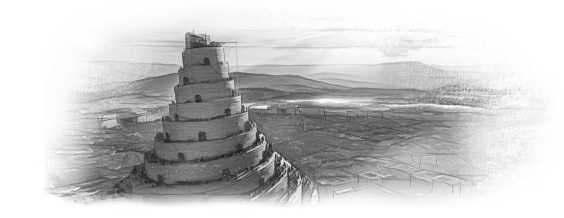
However, the line is broken by the Tower of Babel (Gen. 11:1–9). Once again, God’s plans for humankind are
disrupted. What was supposed to be a blessing, the birth of all nations, becomes another occasion for another
curse. The nations unite in order to try to take God’s place; God responds in judgment on them; and, through the
resulting confusion, the people get scattered throughout the world (Gen. 11:8), thus fulfilling God’s original plan to
“fill the earth” (Gen. 9:1, NKJV).
In the end, in spite of human wickedness, God turns evil into good; He has, as always, the last word. The
curse of Ham in his father’s tent (Gen. 9:21, 22) and the curse of the confused nations at the Tower of Babel (Gen.
11:9) will, eventually, be turned into a blessing for the nations.
* Study this week’s lesson to prepare for Sabbath, April 30.
EGW Notes — SATURDAY ↓
Sabbath Afternoon, April 23
Lesson 5 - All Nations and Babel
Some of the descendants of Noah soon began to apostatize. A portion followed the example of Noah and
obeyed God’s commandments; others were unbelieving and rebellious, and even these did not believe alike in
regard to the Flood. Some disbelieved in the existence of God, and in their own minds accounted for the Flood
from natural causes. Others believed that God existed and that He destroyed the antediluvian race by a flood; and
their feelings, like Cain’s, rose in rebellion against God because He destroyed the people from the earth and cursed
the earth the third time by a flood.
Those who were enemies of God felt daily reproved by the righteous conversation and godly lives of those
who loved, obeyed, and exalted God. The unbelieving consulted among themselves and agreed to separate from
the faithful, whose righteous lives were a continual restraint upon their wicked course. They journeyed a distance
from them and selected a large plain wherein to dwell. They built them a city, and then conceived the idea of
building a large tower to reach unto the clouds, that they might dwell together in the city and tower, and be no
more scattered.—The Story of Redemption, p. 72.
All human ambition, all boasting, is to be laid in the dust. Self, sinful self, is to be abased, not exalted. By
holiness in the daily life we are to reveal Christ to those around us. Corrupt human nature is to be subdued, not
exalted. Thus only can we become pure and undefiled. We are to be humble, faithful men and women. . . .
. . . A faithful record is kept of all the acts of the children of men. Nothing can be concealed from the eye of
the high and holy One that inhabiteth eternity. Some make Christ ashamed of them by their devising and
planning and scheming. God does not approve of their conduct, for the Lord Jesus is dishonored by their spirit and
their works. . . .
The instruction that the Lord has given concerning His work points out the right way. God’s plans and God’s
thoughts are as much higher than man’s plans and man’s thoughts as the heavens are higher than the earth. God’s
voice is to be heard, His wisdom is to guide. He has outlined His plan in His word and in the testimonies that He
has sent to His people. That work only which is carried on in accordance with the principles of His word will
stand fast forever.—Testimonies for the Church, vol. 8, pp. 234, 235.
With untold love our God has loved us, and our love awakens toward Him as we comprehend something of
the length and breadth and depth and height of this love that passeth knowledge. By the revelation of the
attractive loveliness of Christ, by the knowledge of His love expressed to us while we were yet sinners, the
stubborn heart is melted and subdued, and the sinner is transformed and becomes a child of heaven. God does not
employ compulsory measures; love is the agent which He uses to expel sin from the heart. By it He changes pride
into humility, and enmity and unbelief into love and
faith.—Thoughts From the Mount of Blessing, pp. 76, 77.
SUNDAY April 24
The Curse of Ham
Read Genesis 9:18–27. What is the message of this strange story?
* Your notes will not be saved!
Noah’s act in his vineyard echoes Adam’s in the Garden of Eden. The two stories contain common motifs:
eating of the fruit, resulting in nakedness; then a covering, a curse, and a blessing. Noah reconnects with his
Adamic roots and, unfortunately, continues that failed history.
The fermentation of fruit was not a part of God’s original creation. Noah indulged, then lost self-control and
uncovered himself. The fact that Ham “saw” his nakedness hints at Eve, who also “saw” the forbidden tree (Gen.
3:6). This parallel suggests that Ham did not just “see” furtively, by accident, his father’s nakedness. He went
around and talked about it, without even trying to take care of his father’s problem. In contrast, his brothers’
immediate reaction to cover their father, while Ham left him naked, implicitly denounced Ham’s actions.
The issue at stake here is more about the respect of one’s parents. Failure to honor your parents, who
represent your past, will affect your future (Exod. 20:12; compare with Eph. 6:2). Hence the curse, which will
influence Ham’s future and that of his son Canaan.
Of course, it is a gross theological mistake and an ethical crime to use this text to justify racist theories
against anyone. The prophecy is restricted to Canaan, Ham’s son. The biblical author has in mind some of the
corrupt practices of the Canaanites (Gen. 19:5–7, 31–35).
In addition, the curse contains a promise of blessing, playing on the name “Canaan,” which is derived from
the verb kana‘, meaning “subdue.” It is through the subduing of Canaan that God’s people, the descendants of
Shem, will enter the Promised Land and prepare the way for the coming of the Messiah, who will enlarge Japheth
“in the tents of Shem” (Gen. 9:27). This is a prophetic allusion to the expansion of God’s covenant to all nations,
which will embrace Israel’s message of salvation to the world (Dan. 9:27, Isa. 66:18–20, Rom. 11:25). The curse of
Ham will, in fact, be a blessing for all nations, including whichever descendants of Ham and Canaan accept the
salvation offered them by the Lord.
Noah, the “hero” of the Flood, drunk? What should this tell us about how flawed we all are and why
we need God’s grace every moment of our lives?
EGW Notes — SUNDAY ↓
Sunday, April 24
The Curse of Ham
To repeople the desolate earth, which the Flood had so lately swept from its moral corruption, God had
preserved but one family, the household of Noah, to whom He had declared, “Thee have I seen righteous before
Me in this generation.” Genesis 7:1. Yet in the three sons of Noah was speedily developed the same great
distinction seen in the world before the Flood. In Shem, Ham, and Japheth, who were to be the founders of the
human race, was foreshadowed the character of their posterity.
Noah, speaking by divine inspiration, foretold the history of the three great races to spring from these fathers
of mankind. Tracing the descendants of Ham, through the son rather than the father, he declared, “Cursed be
Canaan; a servant of servants shall he be unto his brethren.” The unnatural crime of Ham declared that filial
reverence had long before been cast from his soul, and it revealed the impiety and vileness of his character. These
evil characteristics were perpetuated in Canaan and his posterity, whose continued guilt called upon them the
judgments of God. . . .
The prophecy of Noah was no arbitrary denunciation of wrath or declaration of favor. It did not fix the
character and destiny of his sons. But it showed what would be the result of the course of life they had severally
chosen and the character they had developed. It was an expression of God’s purpose toward them and their
posterity in view of their own character and conduct. As a rule, children inherit the dispositions and tendencies of
their parents, and imitate their example; so that the sins of the parents are practiced by the children from
generation to generation. Thus the vileness and irreverence of Ham were reproduced in his posterity, bringing a
curse upon them for many generations. “One sinner destroyeth much good.” Ecclesiastes 9:18.
On the other hand, how richly rewarded was Shem’s respect for his father; and what an illustrious line of holy
men appears in his posterity! “The Lord knoweth the days of the upright,” “and his seed is blessed.” Psalm 37:18,
26.—Patriarchs and Prophets, pp. 117, 118.
Repentance, as well as forgiveness, is the gift of God through Christ. It is through the influence of the Holy
Spirit that we are convicted of sin, and feel our need of pardon. None but the contrite are forgiven; but it is the
grace of God that makes the heart penitent. He is acquainted with all our weaknesses and infirmities, and He will
help us.
Some who come to God by repentance and confession, and even believe that their sins are forgiven, still fail of
claiming, as they should, the promises of God. They do not see that Jesus is an ever-present Saviour; and they are
not ready to commit the keeping of their souls to Him, relying upon Him to perfect the work of grace begun in
their hearts. . . . There are no victories in this kind of faith. Such persons toil to no purpose; their souls are in
continual bondage, and they find no rest until their burdens are laid at the feet of
Jesus.—Selected Messages, book 1, p. 353.
MONDAY April 25
The Genesis Genealogy
The chronological information about Noah’s age makes us realize that Noah serves as a link between the pre-
Flood and the post-Flood civilizations. The last two verses of the preceding story (Gen. 9:28, 29) take us back to the
last link of the genealogy of Adam (Gen. 5:32). Because Adam died when Lamech, Noah’s father, was 56 years old,
Noah must surely have heard stories about Adam, which he could have transmitted to his descendants before and
after the Flood.
Read Genesis 10. What is the purpose of this genealogy in the Bible? (See also Luke 3:23–38.)
The biblical genealogy has three functions. First, it emphasizes the historical nature of the biblical events,
which are related to real people who lived and died and whose days are precisely numbered. Second, it
demonstrates the continuity from antiquity to the contemporary time of the writer, establishing a clear link from
the past to the “present.” Third, it reminds us of human fragility and of the tragic effect of sin’s curse and its
deadly results on all the generations that have followed.
Note that the classification of “Hamite,” “Semite,” and “Japhethite” does not follow clear criteria. The 70
nations foreshadow the 70 members of the family of Jacob (Gen. 46:27) and the 70 elders of Israel in the wilderness
(Exod. 24:9). The idea of a correspondence between the 70 nations and the 70 elders suggests the mission of Israel
toward the nations: “When the Most High divided their inheritance to the nations, when He separated the sons of
Adam, He set the boundaries of the peoples according to the number of the children of Israel” (Deut. 32:8, NKJV).
Along the same line, Jesus sends 70 disciples to evangelize (Luke 10:1).
What this information shows us is the direct link between Adam and the patriarchs; they all are historical
figures, real people from Adam onward. This also helps us understand that the patriarchs had direct access to
witnesses who had personal memories of these ancient events.
Read Matthew 1:1–17. What does this teach us about how historical all these people were? Why is
knowing and believing that they were real people important for our faith?
EGW Notes — MONDAY ↓
Monday, April 25
The Genesis Genealogy
When consideration is given to man’s opportunities for research; how brief his life; how limited his sphere of
action; how restricted his vision; how frequent and how great the errors in his conclusions, especially as concerns
the events thought to antedate Bible history; how often the supposed deductions of science are revised or cast
aside; with what readiness the assumed period of the earth’s development is from time to time increased or
diminished by millions of years; and how the theories advanced by different scientists conflict with one another,—
considering all this, shall we, for the privilege of tracing our descent from germs and mollusks and apes, consent
to cast away that statement of Holy Writ, so grand in its simplicity, “God created man in His own image, in the
image of God created He him”? Genesis 1:27. Shall we reject that genealogical record,—prouder than any treasured
in the courts of kings,—“which was the son of Adam, which was the son of God”? Luke 3:38.
Rightly understood, both the revelations of science and the experiences of life are in harmony with the
testimony of Scripture to the constant working of God.—Education, p. 130.
In the annals of human history, the growth of nations, the rise and fall of empires, appear as if dependent on
the will and prowess of man; the shaping of events seems, to a great degree, to be determined by his power,
ambition, or caprice. But in the word of God the curtain is drawn aside, and we behold, above, behind, and
through all the play and counterplay of human interest and power and passions, the agencies of the All-merciful
One, silently, patiently working out the counsels of His own will.
In words of matchless beauty and tenderness, the apostle Paul set before the sages of Athens the divine
purpose in the creation and distribution of races and nations. “God that made the world and all things therein,”
declared the apostle, “hath made of one blood all nations of men for to dwell on all the face of the earth, and hath
determined the times before appointed, and the bounds of their habitation; that they should seek the Lord, if haply
they might feel after Him, and find Him.” Acts
17:24-27.—Prophets and Kings, pp. 499, 500.
The Bible presents a boundless field for the imagination, as much higher and more ennobling in character
than the superficial creations of the unsanctified intellect as the heavens are higher than the earth. The inspired
history of our race is placed in the hands of every individual. All may now begin their research. They may become
acquainted with our first parents as they stood in Eden, in holy innocency, enjoying communion with God and
sinless angels. They may trace the introduction of sin and its results upon the race, and follow, step by step, down
the track of sacred history, as it records the disobedience and impenitence of man and the just retribution for
sin.—Messages to Young People, p. 255.
TUESDAY April 26
One Language
Read Genesis 11:1–4. Why were the people of “the whole earth” so keen to achieve unity?
The phrase “the whole earth” refers to a small number of people, those alive after the Flood. The reason for
this gathering is clearly indicated: they want to build a tower to reach the heavens (Gen. 11:4). In fact, their real
intention is to take the place of God Himself, the Creator. Significantly, the description of the people’s intentions
and actions echo God’s intentions and actions in the Creation account: “they said” (Gen. 11:3, 4; compare with Gen.
1:6, 9, 14, etc.); “let us make” (Gen. 11:3, 4; compare with Gen. 1:26). Their intention is explicitly stated: “ ‘Let us
make a name for ourselves’ ” (Gen. 11:4, NKJV), an expression that is exclusively used for God (Isa. 63:12, 14).
In short, the builders of Babel entertained the misplaced ambition to replace God, the Creator. (We know who
inspired that, don’t we? See Isa. 14:14.) The memory of the Flood surely must have played a role in their project.
They built a high tower in order to survive another flood, were another to come, despite God’s promise. The
memory of the Flood has been preserved in Babylonian tradition, albeit distorted, in connection with the
construction of the city of Babel (Babylon). This upward effort to reach heaven and usurp God will, indeed,
characterize the spirit of Babylon.
This is why the story of the Tower of Babel is such an important motif in the book of Daniel, as well. The
reference to Shinar, which introduces the story of the Tower of Babel (Gen. 11:2), reappears at the beginning of the
book of Daniel, in order to designate the place where Nebuchadnezzar has brought the articles of the temple of
Jerusalem (Dan. 1:2). Among many other passages of the book, the episode of Nebuchadnezzar’s erecting the
golden statue, probably on the same place in the same “plain,” is the most illustrative of this frame of mind. In his
visions of the end, Daniel sees the same scenario of the nations of the earth gathering together to achieve unity
against God (Dan. 2:43, Dan. 11:43–45; compare with Rev. 16:14–16), though this attempt fails here, as it did at
Babel, as well.
A famous secular French writer in the past century said the great purpose of humanity was to try “to be God.” What is it about us,
starting with Eve in Eden (Gen. 3:5), that gets drawn into this dangerous lie?
EGW Notes — TUESDAY ↓
Tuesday, April 26
One Language
No sooner was the earth repeopled than men resumed their hostility to God and heaven. They transmitted
their enmity to their posterity, as though the art and device of misleading men, and causing them to continue the
unnatural warfare, was a sacred legacy.
This confederacy was born of rebellion against God. The dwellers on the plain of Shinar established their
kingdom for self-exaltation, not for the glory of God. Had they succeeded, a mighty power would have borne
sway, banishing righteousness, and inaugurating a new religion. The world would have been demoralized. The
mixture of religious ideas with erroneous theories would have resulted in closing the door to peace, happiness,
and security. These suppositions, erroneous theories, carried out and perfected, would have directed minds from
allegiance to the divine statutes, and the law of Jehovah would have been ignored and forgotten. Determined men,
inspired and urged on by the first great rebel, would have resisted any interference with their plans or their evil
course. In the place of the divine precepts they would have substituted laws framed in accordance with the desires
of their selfish hearts, in order that they might carry out their purposes.—Ellen G. White Comments, in
The SDA Bible Commentary, vol. 1, pp. 1091, 1092.
[The enemies of God] reasoned that they would secure themselves in case of another flood, for they would
build their tower to a much greater height than the waters prevailed in the time of the Flood, and all the world
would honor them, and they would be as gods and rule over the people. This tower was calculated to exalt its
builders, and was designed to turn the attention of others who should live upon the earth from God to join with
them in their idolatry. Before the work of building was accomplished, people dwelt in the tower. Rooms were
splendidly furnished, decorated, and devoted to their idols. Those who did not believe in God imagined if their
tower could reach unto the clouds, they would be able to discover reasons for the
Flood.—The Story of Redemption, pp. 72, 73.
In the Word of God are represented two contending parties that influence and control human agencies in our
world. Constantly these parties are working with every human being. Those who are under God’s control and
who are influenced by the heavenly angels, will be able to discern the crafty workings of the unseen powers of
darkness. Those who desire to be in harmony with the heavenly agencies should be intensely in earnest to do
God’s will. They must give no place whatever to Satan and his angels.
But unless we are constantly on guard, we shall be overcome by the enemy. Although a solemn revelation of
God’s will concerning us has been revealed to all, yet a knowledge of His will does not set aside the necessity of
offering earnest supplications to Him for help, and of diligently seeking to cooperate with Him in answering the
prayers offered. He accomplishes His purposes through human instrumentalities.—Ellen G. White Comments, in
The SDA Bible Commentary, vol. 6, p. 1119.
WEDNESDAY April 27
“Let Us Go Down”
Read Genesis 11:5–7 and Psalm 139:7–12. Why did God come down to the earth here? What was the
event that motivated this divine reaction?
Ironically, although the men were going up, God had to come down to them. The descent of God is an
affirmation of His supremacy. God will always be beyond our human reach. Any human effort to rise up to Him
and to meet Him in heaven is useless and ridiculous. No question, that’s why, in order to save us, Jesus came
down to us; there was, indeed, no other way for Him to save us.
A great irony in the Tower of Babel account is seen in God’s statement: “to see the city and the tower” (Gen.
11:5). God did not have to come down to see (Ps. 139:7–12; compare with Ps. 2:4), but He did so anyway. The
concept emphasizes God’s involvement with humanity.
Read Luke 1:26–33. What does this teach us about God’s coming down to us?
The descent of God reminds us also of the principle of righteousness by faith and of the process of God’s
grace. Whatever work we may perform for God, He will still have to come down to meet with us. It is not what
we do for God that will bring us to Him and to redemption. Instead, it is God’s move toward us that will save us.
In fact, the text in Genesis talks twice about God going “down,” which seems to imply how much He cared about
what was happening there.
According to the text, the Lord wanted to put an end to the people’s deep-seated unity, which—given their
fallen state—could lead only to more and more evil. That’s why He chose to confuse their languages, which would
bring an end to their united schemes.
“The schemes of the Babel builders ended in shame and defeat. The monument to their pride became the
memorial of their folly. Yet men are continually pursuing the same course—depending upon self, and rejecting
God’s law. It is the principle that Satan tried to carry out in heaven; the same that governed Cain in presenting his
offering.”—Ellen G. White, Patriarchs and Prophets, p. 123.
How do we see in the Tower of Babel account another example of human hubris and how,
ultimately, it will fail? What personal lessons can we take from this story?
EGW Notes — WEDNESDAY ↓
Wednesday, April 27
“Let Us Go Down”
[Christ] came to this world in human form, to live a man amongst men. He assumed the liabilities of human
nature, to be proved and tried. In His humanity He was a partaker of the divine nature. In His incarnation He
gained in a new sense the title of the Son of God. . . . While the Son of a human being, He became the Son of God
in a new sense. Thus He stood in our world—the Son of God, yet allied by birth to the human race.
Christ came in human form to show the inhabitants of the unfallen worlds and of the fallen world that ample
provision has been made to enable human beings to live in loyalty to their Creator. He endured the temptations
that Satan was permitted to bring against Him, and resisted all his assaults. He was sorely afflicted, and hard
beset, but God did not leave Him without recognition. When He was baptized of John in Jordan, as He came up
out of the water, the Spirit of God, like a dove of burnished gold, descended upon Him, and a voice from heaven
said, “This is my beloved Son, in whom I am well pleased”
(Matthew 3:17).—Selected Messages, book 1, pp. 226, 227.
God sees the sinner. . . . David was a repentant man, and although he confessed and hated his sin, he could
not forget it.
He exclaimed, “Whither shall I go from Thy Spirit? or whither shall I flee from Thy presence? If I ascend up
into heaven, Thou art there: if I make my bed in hell, behold, Thou art there. If I take the wings of the morning,
and dwell in the uttermost parts of the sea; even there shall Thy hand lead me. . . . Yea, the darkness hideth not
from Thee; but the night shineth as the day” [Psalm 139:7-12].
God is everywhere. He sees, He knows, all things, and understands the intents and purposes of the heart. It is
in vain that an attempt should be made to conceal sin from His notice. He saw our first parents in Eden. He saw
Cain when he raised his hand to kill Abel. He saw the sins of the inhabitants of the old world, and numbered their
days and punished them with a flood. He saw the sins of His own covenant people, the Jews, when they plotted
against the life of the Son of
God.—Testimonies on Sexual Behavior, Adultery, and Divorce, p. 89.
There are tower builders in our time. Infidels construct their theories from the supposed deductions of
science, and reject the revealed word of God. . . . In the professedly Christian world many turn away from the
plain teachings of the Bible and build up a creed from human speculations and pleasing fables, and they point to
their tower as a way to climb up to heaven. . . .
The time of God’s investigation is at hand. The Most High will come down to see that which the children of
men have builded. His sovereign power will be revealed; the works of human pride will be laid
low.—Conflict and Courage, p. 42.
THURSDAY April 28
The Redemption of the Exile
Read Genesis 11:8, 9 and Genesis 9:1; compare these with Genesis 1:28. Why is God’s dispersion
redemptive?
God’s design and blessing for humans was that they would “ ‘multiply, and fill the earth’ ” (Gen. 9:1, NKJV;
compare with Gen. 1:28, NKJV). Against God’s plan, the builders of Babel preferred to stick together as the same
people. One reason they said they wanted to build the city was so that they would not “ ‘be scattered abroad over
the face of the whole earth’ ” (Gen. 11:4, NKJV). They refused to move elsewhere, perhaps thinking that together
they would be more powerful than they would be separated and scattered. And, in one sense, they were right.
Unfortunately, they sought to use their united power for evil, not good. They wanted to “ ‘make a name for
ourselves,’ ” a powerful reflection of their own arrogance and pride. Indeed, whenever humans, in open defiance
of God, want to “ ‘make a name’ ” for themselves, we can be sure it won’t turn out well. It never has.
Hence, in a judgment against their outright defiance, God scattered them across “the face of all the earth”
(Gen. 11:9), exactly what they didn’t want to happen.
Interestingly enough, the name Babel, which means “door of God,” is related to the verb balal, which means
“confuse” (Gen. 11:9). It is because they wanted to reach the “door” of God, because they thought of themselves as
God, that they ended up confused and much less power ful than before.
“The men of Babel had determined to establish a government that should be independent of God. There were
some among them, however, who feared the Lord, but who had been deceived by the pretensions of the ungodly
and drawn into their schemes. For the sake of these faithful ones the Lord delayed His judgments and gave the
people time to reveal their true character. As this was developed, the sons of God labored to turn them from their
purpose; but the people were fully united in their Heaven-daring undertaking. Had they gone on unchecked, they
would have demoralized the world in its infancy. Their confederacy was founded in rebellion; a kingdom
established for self-exaltation, but in which God was to have no rule or honor.”—Ellen G. White, Patriarchs and
Prophets, p. 123.
Why must we be very careful about seeking to “make a name” for ourselves?
EGW Notes — THURSDAY ↓
Thursday, April 28
The Redemption of the Exile
[The enemies of God] exalted themselves against God. But He would not permit them to complete their work.
They had built their tower to a lofty height when the Lord sent two angels to confound them in their work. Men
had been appointed for the purpose of receiving word from the workmen at the top of the tower, calling for
material for their work, which the first would communicate to the second, and he to the third, until the word
reached those on the ground. As the word was passing from one to another in its descent, the angels confounded
their language, and when the word reached the workmen upon the ground, material was called for which had not
been required. And after the laborious process of getting the material to the workmen at the top of the tower, it
was not that which they wished for. Disappointed and enraged, they reproached those whom they supposed were
at fault.
After this there was no harmony in their work. Angry with one another, and unable to account for the
misunderstanding and strange words among them, they left the work and separated from each other and scattered
abroad in [the] earth. Up to this time men had spoken but one language. Lightning from heaven, as a token of
God’s wrath, broke off the top of their tower, casting it to the ground. Thus God would show to rebellious man
that He is supreme.—The Story of Redemption, p. 73.
In mercy [God] confounded their speech, thus putting a check on their purposes of rebellion. God bears long
with the perversity of men, giving them ample opportunity for repentance; but He marks all their devices to resist
the authority of His just and holy law. From time to time the unseen hand that holds the scepter of government is
stretched out to restrain iniquity. Unmistakable evidence is given that the Creator of the universe, the One infinite
in wisdom and love and truth, is the Supreme Ruler of heaven and earth, and that none can with impunity defy
His power.
The schemes of the Babel builders ended in shame and defeat. The monument to their pride became the
memorial of their folly. Yet men are continually pursuing the same course—depending upon self, and rejecting
God’s law. It is the principle that Satan tried to carry out in heaven; the same that governed Cain in presenting his
offering.—Patriarchs and Prophets, p. 123.
[God] is the Maker of all mankind. All men are of one family by creation, and all are one through redemption.
Christ came to demolish every wall of partition, to throw open every compartment of the temple courts, that
every soul may have free access to God. His love is so broad, so deep, so full, that it penetrates everywhere. It lifts
out of Satan’s influence those who have been deluded by his deceptions, and places them within reach of the
throne of God, the throne encircled by the rainbow of promise. In Christ there is neither Jew nor Greek, bond nor
free.—Prophets and Kings, pp. 369, 370.
FRIDAY July 29
Further Thought: Read Ellen G. White, “The Tower of Babel,” pp. 117–124, in Patriarchs and Prophets.
“They decided to build a city, and in it a tower of such stupendous height. . . . These enterprises were
designed to prevent the people from scattering abroad in colonies. God had directed men to disperse throughout
the earth, to replenish and subdue it; but these Babel builders determined to keep their community united in one
body, and to found a monarchy that should eventually embrace the whole earth. Thus their city would become the
metropolis of a universal empire; its glory would command the admiration and homage of the world and render
the founders illustrious. The magnificent tower, reaching to the heavens, was intended to stand as a monument of
the power and wisdom of its builders, perpetuating their fame to the latest generations.
“The dwellers on the plain of Shinar disbelieved God’s covenant that He would not again bring a flood upon
the earth. Many of them denied the existence of God and attributed the Flood to the operation of natural causes.
Others believed in a Supreme Being, and that it was He who had destroyed the antediluvian world; and their
hearts, like that of Cain, rose up in rebellion against Him. One object before them in the erection of the tower was
to secure their own safety in case of another deluge. By carrying the structure to a much greater height than was
reached by the waters of the Flood, they thought to place themselves beyond all possibility of danger. And as they
would be able to ascend to the region of the clouds, they hoped to ascertain the cause of the Flood. The whole
undertaking was designed to exalt still further the pride of its projectors and to turn the minds of future
generations away from God and lead them into idolatry.”—Ellen G. White, Patriarchs and Prophets, pp. 118, 119.
Discussion Questions:
-
1. What example do we have from history, or even the present, of the trouble that can come from those who seek to make a name
for themselves?
-
2. How can we, as a church, avoid the danger of seeking to build our own Tower of Babel? What are ways we might actually be
seeking to do this, even subconsciously?
EGW Notes — FRIDAY ↓
Friday, April 29
For Further Reading
The Ministry of Healing, “God’s Plans the Best,” pp. 473, 474;
Patriarchs and Prophets, “The Tower of Babel,” pp. 117–124.